Notice: Function _load_textdomain_just_in_time was called incorrectly. Translation loading for the acf domain was triggered too early. This is usually an indicator for some code in the plugin or theme running too early. Translations should be loaded at the init action or later. Please see Debugging in WordPress for more information. (This message was added in version 6.7.0.) in /home2/equitash/public_html/inst/wp-includes/functions.php on line 6131

Notice: Function _load_textdomain_just_in_time was called incorrectly. Translation loading for the modern-events-calendar-lite domain was triggered too early. This is usually an indicator for some code in the plugin or theme running too early. Translations should be loaded at the init action or later. Please see Debugging in WordPress for more information. (This message was added in version 6.7.0.) in /home2/equitash/public_html/inst/wp-includes/functions.php on line 6131

Notice: Function _load_textdomain_just_in_time was called incorrectly. Translation loading for the wpfront-user-role-editor domain was triggered too early. This is usually an indicator for some code in the plugin or theme running too early. Translations should be loaded at the init action or later. Please see Debugging in WordPress for more information. (This message was added in version 6.7.0.) in /home2/equitash/public_html/inst/wp-includes/functions.php on line 6131

Notice: Function _load_textdomain_just_in_time was called incorrectly. Translation loading for the kirki domain was triggered too early. This is usually an indicator for some code in the plugin or theme running too early. Translations should be loaded at the init action or later. Please see Debugging in WordPress for more information. (This message was added in version 6.7.0.) in /home2/equitash/public_html/inst/wp-includes/functions.php on line 6131

Notice: Function _load_textdomain_just_in_time was called incorrectly. Translation loading for the agama-pro domain was triggered too early. This is usually an indicator for some code in the plugin or theme running too early. Translations should be loaded at the init action or later. Please see Debugging in WordPress for more information. (This message was added in version 6.7.0.) in /home2/equitash/public_html/inst/wp-includes/functions.php on line 6131

Warning: Cannot modify header information - headers already sent by (output started at /home2/equitash/public_html/inst/wp-includes/functions.php:6131) in /home2/equitash/public_html/inst/wp-includes/feed-rss2.php on line 8
Uncategorized – Equitas Health Institute https://inst.equitashealth.org Education • Training • Consulting Sat, 18 Apr 2020 10:57:26 +0000 en-US hourly 1 https://wordpress.org/?v=6.9.4 https://inst.equitashealth.org/wp-content/uploads/EquitasHealth_logo-symbol-150x150.png Uncategorized – Equitas Health Institute https://inst.equitashealth.org 32 32 We’re #stillteaching during COVID-19 https://inst.equitashealth.org/2020/04/were-stillteaching-during-covid-19/uncategorized/ Fri, 17 Apr 2020 12:21:51 +0000 http://inst.equitashealth.org/?p=1831
Read More]]>
The “new normal” must include affirming healthcare. That’s why we’re now offering all of our workshops and trainings as webinars.

Recently Lead Trainer Ramona Peel conducted a live webinar titled, “Combatting Bias via Cultural Humility: Making Historical Sites More Inclusive for the LGBTQ+ Community,” with AmeriCorps members at the Ohio History Connection. Here’s what one participant had to say:

“I am so glad we still had the opportunity to learn how historical sites can combat bias with cultural humility, even though the in-person training had to be cancelled. This webinar showed me how to foster empathy and inclusivity by grounding those concepts in life experiences. The personal narratives Ramona shared helped make the goals of cultural humility, and the means of practicing it, tangible and relatable.”

Book your Equitas Health Institute Training today at: http://equitashealthinstitute.com/trainings/

]]>
LGBTQ+ Provider Guide Now Digital! https://inst.equitashealth.org/2020/04/lgbtq-provider-guide-now-digital/uncategorized/ Thu, 16 Apr 2020 20:17:44 +0000 http://inst.equitashealth.org/?p=1856
Read More]]>
The Equitas Health Institute Provider Guide is a listing of Ohio medical and social service providers who offer varying degrees and types of LGBTQ+ affirming care. Now you can search the guide by geographic region on our website!

Providers listed in this guide answered “yes” to at least one of the following questions. When searching the guide, you’ll use tthe corresponding symbols to determine the nature of LGBTQ+ affirming services each provider offers.

PROVIDER COLOR KEY:

Has had LGBTQ-specific cultural competency training. Have you received any LGBTQ-specific competency training?

Uses LGBTQ-inclusive language on forms and paperwork. Does your paperwork provide space for patients to indicate their relationship status as partnered, differentiate between their sex and gender, and indicate preferred name and pronouns?

Provides LGBTQ-specific education materials. Does your office have any visible or available educational/supportive materials printed specifically for the LGBTQ community?

Provides Trans-specific services. Do you provide trans-specific services?

Has had LGBTQ+ specific cultural competency training with Equitas Health Institute.

Start searching now!

]]>
Transforming Care 2020: Call for Abstracts https://inst.equitashealth.org/2020/04/transforming-care-2020-call-for-abstracts/uncategorized/ Wed, 15 Apr 2020 17:29:29 +0000 http://inst.equitashealth.org/?p=1835
Read More]]>
We are excited to announce we are accepting abstracts for the 2020 Transforming Care Conference between April 6, 2020 and May 22, 2020. Transforming Care has come to be known as the most comprehensive conference on LGBTQ+ HIV health equity in the country. Conference participants tell us that what makes TCC so transformative is the mix of people—researchers, practitioners, activists, community members all broadening each other’s perspectives. This year’s TCC theme will be The Invisibles.

SUBMIT A PROPOSAL

We seek proposals presented by and geared toward medical providers, mental health providers, social workers, activists, researchers, people living with HIV, and/or LGBTQ+ community members. Proposals should be interactive, engaging, and relevant to the learning objectives and theme of the conference. We welcome a variety of proposal types, including oral presentations, workshops, panels, posters, and holistic health activities. Proposals may be submitted by individuals or groups and we value both professional and lived experience. The Transforming Care Conference is committed to uplifting the voices of individuals and communities with marginalized identities. We especially encourage abstract submissions from people living with HIV/AIDS, LGBTQ+ folks, people of color, people with disabilities, incarcerated and formerly incarcerated people, people who are undocumented, youth and elders, women, people experiencing poverty, and others with marginalized identities. We are looking for proposals that will:

    • Go beyond a PowerPoint presentation and get conference attendees actively engaged
    • Boost the energy of conference attendees
    • Break down barriers and promote collaboration
    • Highlight new or innovative work
    • Creative a positive and safe learning experience

We are committed to including people who do not have experience applying to present or presenting at conferences. If you would like assistance with the creation and submission of your abstract, the Abstract Committee is more than happy to offer support and mentorship. Please contact us at transformingcare@equitashealth.com to set up a mentoring appointment.

Note: Presentations may be presented in other settings prior to or after the Transforming Care Conference.

]]>
VARIAT Sim App Teaches Empathy https://inst.equitashealth.org/2020/04/variat-sim-app-teaches-empathy/uncategorized/ Wed, 15 Apr 2020 12:29:34 +0000 http://inst.equitashealth.org/?p=1834
Read More]]>
When Nationwide Children’s Hospital developed the new app, VARIAT Sim (Virtual and Augmented Reality Implicit Association Training), they called on the expertise of the Equitas Health Institute to guide their module addressing implicit biases toward sexual orientation and gender identity (SOGI) in a healthcare setting.

The VARIAT Sim app provides healthcare workers an in-person, onsite perspective to promote empathy and decrease implicit bias. By successfully completing the SOGI module, Medicaid providers will:


  • Increase their awareness of implicit biases.
  • Learn how biases and social determinants of health lead to inequitable care.
  • Acquire strategies and resources to minimize health disparities.
  • Receive a certificate of completion and Continuing Medical Education credits


We’re proud to have been part of developing this innovative and critical training format.

Look for VARIAT wherever you get your apps, and start learning today!

]]>
Ramona’s Speech at Yellow Springs Pride – June 27, 2019 https://inst.equitashealth.org/2019/07/how-to-prepare-for-overnight-guests-2/uncategorized/ Wed, 03 Jul 2019 10:26:51 +0000 https://websitedemos.net/interior-firm-02/?p=426

Pride is a call to action!

The following is the prepared text of the speech Lead Trainer Ramona Peel delivered at the Yellow Springs Pride Kick-Off event on June 27, 2019:

I’m honored to speak with y’all tonight. Pride means a lot of different things to people. It’s a celebration of who we are—a collective shout that we are here, not just as individuals, but as a community that will no longer politely accept being mistreated and dehumanized.

It’s a venue for self-expression. For many people, including myself, a Pride Parade or festival might be the first time one is “out” in public as their authentic selves. It might also be an experience that gives an LGBTQ+ person a nudge (or a shove) out of the closet.

It’s a commemoration of loved ones we’ve lost—from our friends and family members who lost their lives to HIV/AIDS, to our siblings who we’ve lost to horrific violence, from Matthew Shepard to Brandon Teena, to those who perished at Pulse, to Dana Martin, Jazzaline Ware, Ashanti Carmon, Claire Legato, Muhlaysia Booker, Michelle ‘Tamika’ Washington, Paris Cameron, Chynal Lindsey, Chanel Scurlock, Zoe Spears, and Brooklyn Lindsey. We honor and remember these 11 black trans women, as well as all other members of the LGBTQ+ community that we have lost so far this year. Beyond that, we also solemnly recognize the other things we can lose just because of who we are or who we love. Lost friends. Lost family members. Lost lovers. Lost opportunity. Lost TIME.

Ramona Peel speaking to crowd at Yellow Springs Brewery
More than anything, Pride has always been a call to action. It’s often said that the first Pride was a riot—and that’s true. The Stonewall Uprising WAS a galvanizing moment for members of sexual and gender minorities across the globe. I’d like to talk tonight not only about Stonewall and its legacy, but also about what led up to the rebellion, what it has led to, and about the hard work we have ahead of us to complete what began when the first bricks flew at the Stonewall Inn 50 years ago this month.

The Stonewall Uprising is an event that has passed into legend in our community and beyond. Briefly, I’d like to lay out the context in which the rebellion occurred, and the major events of the rebellion itself.


In June 1969, it was quite literally illegal to be an LGBTQ+ person. In nearly all of the United States, same-sex personal displays of affection, or dressing in a manner that didn’t match the gender norms associated with your sex assigned at birth, could result in being charged with a crime. Being outed as LGBTQ+ could result not just in legal peril, but also in the loss of relationships, of careers, and of basic needs like housing.


In New York City, it was common for the NYPD to raid gay and lesbian bars like the Stonewall Inn. One such raid occurred 50 years ago tonight. Eight undercover officers entered the bar and arrested Stonewall employees, drag queens, and other people violating a law against “masquerading” as a member of the “opposite sex.”


A crowd began to form around the Stonewall Inn, and witnessed police loading those arrested into vans. Lesbian activist and drag king Storme DeLarveire was arrested, hit on the head with a billy club, and handcuffed. Bleeding from a head wound, she yelled at the gathered crowd “Why don’t you so something?” Two trans women of color, Marsha P. Johnson and Sylvia Rivera, resisted arrest and, by multiple accounts, began the physical resistance to the NYPD by throwing bricks and bottles.


By 4am, the NYPD had retreated from the swelling crowd and barricaded themselves inside the Stonewall Inn. Rioters used parking meters to try and break through the door. Others threw beer bottles and even homemade firebombs.


On June 28th, the Stonewall reopened, and that night, a crowd yet again gathered around the bar. The NYPD beat and teargassed members of the crowd until the early morning hours, dispersing the crowd. Despite this, crowds still gathered at the Stonewall for several additional nights, taking advantage of the moment to spread information and build the community that would fuel the later growth of the gay rights movement.


Media coverage was rife with homophobia, and festooned with insults and slurs. On July 2nd, a crowd gathered to protest the coverage by the Village Voice. Rioting began anew, but was over by midnight. The Stonewall Uprising was the catalyst for the explosive growth of the LGBTQ+ movement that would follow.


A year later, in June 1970, The Cristopher Street Liberation March capped off New York’s first Gay Pride Week. In the years that followed, the gay Pride movement swept around the country and the globe, and today, hundreds of cities worldwide hold Pride parades and festivals. In Ohio alone there will be a total of 15 Pride parades and/or festivals this year, including Yellow Springs.


In the popular imagination, the LGBTQ rights movement began with the Stonewall Uprising. This isn’t just a misconception—it’s a dangerous misconception that fuels another corrosive myth: that LGBTQ+ folks have no history—that we are a new phenomenon.


Variations in gender identity, gender expression, biological “sex,” and sexual and romantic orientation have been part of the story of our species for eons. They are only seen as abnormal or deviant through a lens clouded by homophobia, transphobia, and patriarchy. This shared experience of bias, prejudice, and discrimination is a major factor that binds sexual and gender minorities together into the LGBTQ+ movement. From antiquity up through the enlightenment, there is ample evidence that LGBTQ+ folks existed, even if their societies pushed them to the margins—or worse.


LGBTQ+ folks haven’t just faced persecution—we’ve also faced attempts to erase us from history. Perhaps the most unsettling example of this is the fate of the Institute fur Sexualwissenschaft, (or, Institute of Sex Research) in Germany before World War II. Between the wars, Berlin had a thriving LGBTQ+ community, and, under the leadership of Magnus Hirschfeld, the Institute not only did groundbreaking research, but it also provided a safe harbor for LGBTQ+ Germans. In particular, its progressive attitude on gender issues, including the first modern application of hormone replacement therapy + gender-affirming surgeries, set it apart. But that also made it a target for the Nazi regime.


In May 1933, the Nazis destroyed the Institute and its research, and later used the institute’s records to hunt down, imprison, and murder members of the LGBTQ+ community. This is a chilling illustration that efforts to marginalize, erase, and even destroy the LGBTQ+ community are nothing new.


In the US, the postwar era saw a significant increase in LGBTQ+ activism, led by groups like the Mattachine Society and the Daughters of Bilities. They fought for equality and acceptance in a particularly-hostile Cold War environment. To name just one example—between 1947 and 1955 alone, 1,200 people were expelled from US government jobs on the suspicion of being gay—a sad precursor to “Don’t Ask, Don’t Tell” and the current administration’s ban on trans folks in the military.


The US government would fail the community again during the AIDS crisis. Not only would President Reagan fail to mention AIDS publicly until 1985, he would also fail to take any meaningful action against the epidemic during his Presidency. It was only via direct action by LGBTQ+ individuals and groups such as ACT UP that the government and the pharmaceutical industry were forced to act. The HIV/AIDS pandemic decimated a generation of LGBTQ+ people and robbed the world of thousands of friends, family members, lovers, artists, and activists. It also, along with the Stonewall Uprising, was a moment that radicalized the community and spurred it into action.


Max Weber once said politics is the slow boring of hard boards—and over the last thirty years, the progress of the LGBTQ+ movement has been simultaneously impressive but incomplete. We’ve seen fundamental changes in society, but we are also frustrated by the amount of work left to be done.


HIV/AIDS is no longer a death sentence—we have the tools, today, to, if not eradicate the disease, at least defeat its ability to destroy lives. However, these tools are not available to everyone—particularly to members of marginalized groups.


We can marry the people we love, and have those unions legally recognized by the state. At the same time, in most of the country, we can still be fired or denied housing because of who we love.


Trans and non-binary people are more visible than ever, and in some places have found acceptance and have access to gender-affirming care. But trans women of color live under a constant threat of violence. And right here in Ohio, the state refuses to let trans folks have their Authentic gender markers on their birth certificates.


Young people are more likely than ever before to identify as LGBTQ+, and that demographic trend shows no sign of slowing. But the current political climate has not only created an atmosphere of dread, it has also emboldened those who hate us and wish to do us harm.


So what does the future hold? What shall we do? Most obviously, we need to keep boring those hard boards. We need to elect officials who will push for LGBTQ+ equality at the local, state, and federal levels. We need to run for office. We need to vote, not just at the ballot box, but also with our feet and our dollars.


We can’t stop, though. The reality is that there will always be work left to do. That is where we find the spirit of Stonewall—even when faced with overwhelming odds, even when burdened by oppression, we fight, and we fight for each other. We don’t say “I got mine.” We don’t pull the ladder up behind us.


Pass the Equality Act? Great! Keep working on eliminating racism within the LGBTQ+ community. Equality under law matters little when systematic racism limits your ability to make a living wage, or secure, stable housing, or to be free from the threat of police violence.


Create more welcoming and inclusive environment for trans folks? Awesome! Still need to work on the same goals for our non-binary siblings—and not to mention our intersex friends, our asexual and aromantic neighbors, and so on.


In this fight, we must never forget the struggle and the pain of those who scratched and clawed to get us where we are today—but we also have a generation of LGBTQ+ youth who will apply their energy to the next battle, then the next, then the next.


That’s what fills me with hope. Our community is incredibly resilient, and when we combine the collective experience and wisdom of those who have seen darker days with the energy and drive of the young people, outraged by the status quo—


I see nothing but victory in our future.


Thank you.

]]>
Breast/Chest Health and the LGBTQ+ Community https://inst.equitashealth.org/2019/06/how-to-prepare-for-overnight-guests/uncategorized/ Thu, 20 Jun 2019 09:32:55 +0000 https://websitedemos.net/interior-firm-02/?p=340

Breast/Chest Health and the LGBTQ+ Community

By Ramona Peel, Lead Trainer

Every October, public spaces across the country are covered in black, orange, and pink. Halloween explains those first two colors, and the third is associated with breast cancer awareness. That campaign is necessary because breast cancer is one of the leading causes of death in the United States, and in many cases lives are cruelly cut short because the disease was too advanced at the point it was detected. We know that early detection of this sort of cancer can significantly increase a person’s chances of long-term survival, so preventative care is one of the best weapons we have against breast cancer.

Unfortunately, the LGBTQ+ community is at a disadvantage when it comes to fighting breast cancer. While we lack a substantial amount of direct data on whether LGBTQ+ people suffer from higher rates of breast cancer than the rest of the population (due to insufficient research and data collection), we can infer that it’s likely that LGBTQ+ folks are at higher risk due to a number of factors.

First, LGBTQ+ people are more likely to suffer from a cluster of health disparities that tend to increase a person’s risk of developing breast cancer. For example, the available data shows that lesbian-identified women are more likely to use and misuse alcohol, tobacco, and other substances (as a way to cope with minority stress) and they are statistically less likely to experience a pregnancy. All of these factors individually increase the likelihood of developing breast cancer, so it’s reasonable to conclude that a population suffering from a cluster of these health disparities would also experience an increased risk of breast cancer.

Secondly, if an LGBTQ+ person seeks out preventative care for this sort of cancer, they are likely to enter an environment that doesn’t seem built to include them. For an example, just the term breast cancer can send the message that trans men and non-binary people who were assigned female at birth are not going to be welcomed or affirmed. Many members of these groups don’t think of or call that part of their bodies breasts, so instead it’s better to talk about breast/chest health/screenings. In a similar fashion, extensive references to this sort of preventative care as “women’s health” or a color scheme that is overwhelmingly pink can also be off-putting to those who need these screenings but do not identify as women.


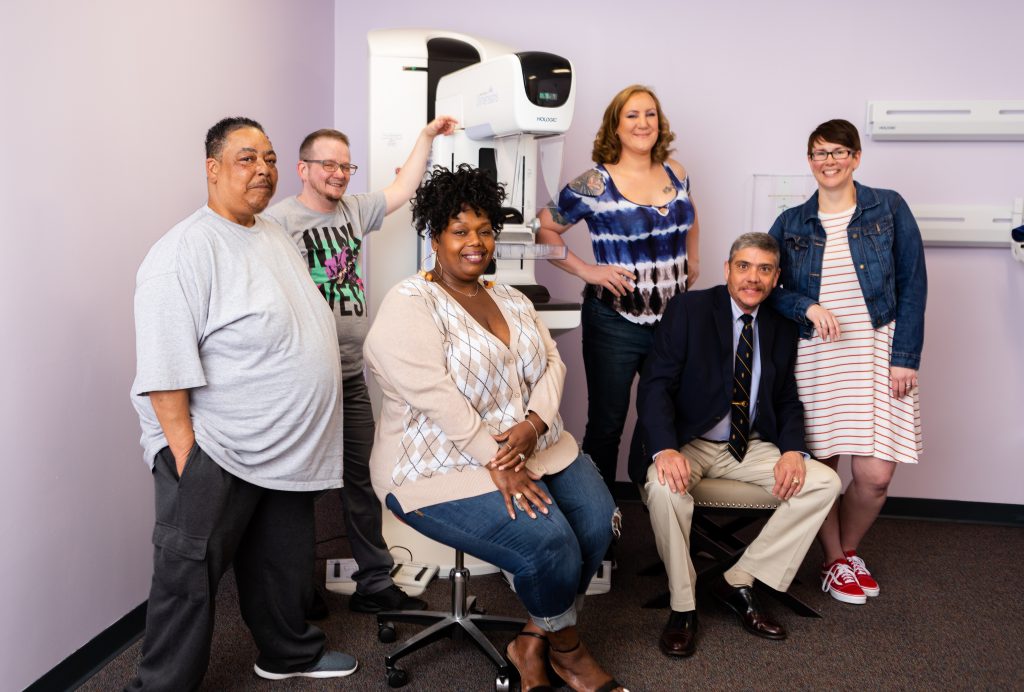
People of various genders and races standing in a mammogram exam room.


In addition, if an institution or its staff doesn’t possess sufficient LGBTQ+ cultural humility, it can also drive away people who need treatment. A trans woman who needs a mammogram is unlikely to make another appointment at a clinic where she was repeatedly misgendered. A bisexual woman is going to avoid getting screenings at an institution where she overheard the staff making insensitive & biphobic remarks, and so on.

The Institute is engaged in an ongoing statewide effort to train mammogram clinics and breast/chest health institutions to be more culturally humble and structurally competent. Another part of this effort is educating community members about when they should be screened for breast/chest cancer and why. With all of this in mind, at 7 pm on June 25th at the Mount Auburn Presbyterian Church in Cincinnati, the Institute will be hosting an LGBTQ+ community conversation about breast/chest health and best practices concerning breast/chest care. Please join us and learn more about who needs screenings, when/how often screenings should occur, and why screenings are needed. Anyone who shows up will be registered in a free raffle drawing, and participants will receive a free t-shirt and cap promoting this campaign (“Go Topless Once A Year”) while supplies last. This event is open to all. No registration required.

No matter who we are or how we feel about our bodies – even if we dislike the color pink, or if we love it and wear it all year long – one thing is true: We deserve breast and chest care that affirms our bodies, genders, and identities. If you have any questions about our breast/chest health programs, or about the June 25 event, please contact Lead Trainer Ramona Peel at ramonapeel@equitashealth.com.

]]>
Another Trump Administration Attack Upon Trans Folks https://inst.equitashealth.org/2019/06/another-trump-administration-attack-upon-trans-folks-and-what-you-can-do-about-it/uncategorized/ Tue, 04 Jun 2019 16:58:05 +0000 http://inst.equitashealth.org/?p=856
Read More]]>
Another Trump Administration Attack Upon Trans Folks – And What You Can Do About It

The Trump Administration is continuing its sustained attack on trans, non-binary, and gender non-conforming people. Coming on the heels of the trans military ban, and a proposal to allow discrimination on the basis of gender identity in homeless shelters, is a new attempt to strip trans folks of rights they gained under the Affordable Care Act.

Before the creation of the Affordable Care Act (also known as Obamacare), many insurance plans excluded transition-related care in their coverage. Additionally, being trans was considered a preexisting condition in some instances, which was used as an excuse to charge unaffordable premiums or deny people insurance coverage. Beyond that, trans people routinely experienced discrimination when seeking care or screenings typically associated with only one of the two binary genders. For example, a trans woman who sought screening for prostate cancer could be refused care at a clinic or hospital. Further, even if they received care, their insurance company could refuse to cover the screening. Finally, transphobic discrimination in health care is widespread. Transgender people may be turned away at the front desk, ignored in the examination room, or even harassed by providers just for being trans. Before the ACA, folks who experienced such discrimination had no legal remedy.

A key provision of the ACA is the ‘Health Care Rights Law’ (also known as ‘Section 1557’). It bans discrimination on the basis of race, color, national origin, sex, age, and disability within health programs and activities that receive federal funding. This includes most health facilities, like hospitals or doctors’ offices, and most health insurance companies. However, even complex legislation like the ACA doesn’t always specifically define every term used in every part of the law. Federal agencies often adopt regulations (also called “rules”) to explain in greater detail what different laws mean. Regulations do not create new protections that weren’t already there or change the law, but they do provide important clarifications about what the law requires. In 2016 (under the Obama Administration), the Department of Health and Human Services (HHS) adopted a rule explaining what Section 1557 means and how it should be enforced. Under the 2016 rule, it was clarified that the prohibition of discrimination on the basis of sex included sexual orientation and gender identity. In short, this means that any facility, health care organization, or insurance provider that receives federal funding cannot discriminate against transgender or LGB+ folks.

Soon after taking control of the executive branch in early 2017, the Trump Administration challenged this Section 1557 rule for the first time. While the active and public challenging of such a rule by the Trump Administration is disheartening and unsettling, it is important to note that the more LGBTQ+ inclusive rule has been and still is in effect.  The Trump Administration recently released a new proposed regulation falsely claiming that 1557 does not protect LGBTQ+ people from discrimination.

While the Trump administration’s proposed regulation won’t change the law—which most courts agree protects transgender people—it encourages the incorrect idea that discriminating against transgender people in health care is legal, and it sends the message that when trans folks do face discrimination, the federal government can’t be trusted to enforce the law.

So where does this leave us?

  1. It is important to remember that the law has not changed.
  2. The Supreme Court has not yet ruled on cases relevant to Section 1557.
  3. Only Congress has the power to change the law by repealing the ACA.

That being said, the Trump Administration’s actions, and the accompanying false claims, will likely cause confusion for many patients, providers, and insurance companies, and it could lead to more anti-trans discrimination. Before this new proposed rule takes effect, there is a period of public comment. Our colleagues at the National Center for Transgender Equality have set up a tool where you can make your voice heard by directly submitting your comment on this attempt to strip trans folks of their rights. If you have further questions about this or any other related topic, please feel free to contact Institute Lead Trainer, Ramona Peel at ramonapeel@equitashealth.com.

]]>
National Transgender HIV Testing Day https://inst.equitashealth.org/2019/04/national-transgender-hiv-testing-day/uncategorized/ Thu, 18 Apr 2019 17:14:51 +0000 http://inst.equitashealth.org/?p=860
Read More]]>
National Transgender HIV Testing Day

By Ramona Peel, Lead Trainer

With actions like the transgender troop ban, the current administration is directly targeting trans, non-binary, and gender non-conforming folks and putting their health, wellness, and overall safety at risk. In addition to these sort of direct attacks, this administration’s attempts to weaken access to health care also puts additional stress on a population that already has an above-average need for health and wellness services. Thankfully, Equitas Health, along with a number of other organizations across Ohio, are working every day to maintain linkage to care for the trans community.

One area of heightened need among trans folks is for HIV education, testing, prevention, and treatment. While we are always in a state of severe need for more (and better) data about this population, the numbers we do have are startling, and should spur institutions and individuals to action.

About six tenths of one percent of the overall US population is living with HIV. According to one 2018 study, Transgender people face elevated HIV risk. This study showed that about 1 in 7 (14%) transgender women overall are living with HIV, and that the percentage is significantly higher among black/African-American (44%) and Hispanic/Latina (26%) transgender women. In addition, an estimated 3% of transgender men have HIV. No specific data on HIV among non-binary folks is yet available.

Trans, non-binary, and gender non-conforming people are more likely to face obstacles that make it harder to access HIV services—such as stigma and discrimination, inadequate employment or housing, and limited access to welcoming, supportive health care. These barriers are significantly more daunting for trans folks of color, disabled trans people, and other trans individuals who experience multiple forms of marginalization. Addressing these barriers is essential to achieving health equity for all transgender people.

The good news? We now know that people living with HIV who are able to adhere to their prescribed medication regimes can achieve viral suppression, and thus not be able to transmit the virus via sexual contact. In addition, people living with HIV who achieve viral suppression have life expectancy near that of the rest of the population. Because of this, it is crucial that at-risk populations, including trans folks, first get tested for HIV, and then start treatment if needed.

Equitas Health provides free HIV testing, often without an appointment, at facilities across the state of Ohio. Here’s a list of our offices around the state that provide these services, and further information can be found at the Ohio HIV/STD Hotline. For those of us living with HIV, Equitas Health also provides a wide range of additional treatments and services. If you have further questions, please contact Community Engagement Manager Dom Ali at dominicali@equitashealth.com.

]]>
2019 LGBT Health Awareness Week https://inst.equitashealth.org/2019/03/2019-lgbt-health-awareness-week/uncategorized/ Wed, 27 Mar 2019 17:18:20 +0000 http://inst.equitashealth.org/?p=863
Read More]]>
2019 LGBT Health Awareness Week

By Ramona Peel, Lead Trainer

This is LGBT Health Awareness Week, and the staff of the Institute would like to tell you about the health and wellness challenges facing this community, and what we are doing to try to improve health outcomes for LGBTQ+ folks in Ohio and beyond.

First of all, it’s important to note the growth of the LGBTQ+ (Lesbian, Gay, Bisexual, Transgender, Queer/Questioning, Intersex, Asexual/Aromantic, Pansexual, and more) community. A 2018 Gallup poll showed that the percentage of the US population that asserts an LGBTQ+ identity grew from 3.5 % in 2012 to 4.5%. Here in Ohio, 4.3% of the state’s adult population is LGBTQ+ (about 391,000 individuals), a larger number of people than the combined populations of Dayton and Akron. Given the relative lack of comprehensive studies focused on the LGBTQ+ community, as well as issues related to sampling methods used by those that do ask about sexual orientation and/or gender identity, these numbers likely understate the size of this population. The same Gallup study shows that those born between 1980 and 1998 account for the majority of this growth.

Given that millennials will outpace baby boomers as the largest generational cohort in the US in 2019, and that younger age cohorts are even more likely to be LGBTQ+, it’s clear that this population will be driving greater demand for health and wellness services in the coming decades. The LGBTQ+ community has grown and is growing, due to culture change and an increase in climates where it is safe to be out, improved measures for accurately counting the LGBTQ+ population, and wider acceptance of the fluidity of gender and sexuality.

This growing community suffers from a range of significant health disparities and inequities. According to the National LGBT Health Education Center, LGBT individuals use tobacco at double the rate of the general US population. In addition, this community experiences elevated rates of mental health issues, including depression, anxiety, post-traumatic stress, and suicidal ideation. Rates of substance use and abuse are above average for LGBT Americans as well. These disparities are strongly (though not exclusively) driven by minority stress. LGBTQ+ people face significant prejudice from both individuals and institutions, and there are no broad statewide protections against discrimination on the basis of sexual orientation or gender identity in Ohio, or in most other US states.

Even though this population has an above-average need for health and wellness services, they are less likely that the rest of the population to be linked to care. In part, this is because LGBTQ+ people face additional barriers to care: The Williams Institute at UCLAhas found that LGBT Ohioans face higher unemployment rates, are more likely to live in poverty, and are less likely to be insured than other Ohio residents. Even when they can access care, those services are far-too-often delivered alongside discrimination and harassment.

According to a study conducted by Lambda Legal, over 50% of LGBTQ+ respondents reported experiencing at least one of the following types of discrimination:

  • being refused needed care
  • health care professionals refusing to touch them or using excessive precautions
  • health care professionals using harsh or abusive language
  • being blamed for their health status
  • health care professionals being physically rough or abusive.

These percentages were even higher for transgender respondents and people of color included in the study.

Ohio is no exception to these national trends. In 2015, the National Center for Transgender Equality conducted a survey that included over 900 trans Ohioans, and found that 26% avoided going to a doctor because of fear of discrimination. Further, 32% reported at least one negative experience in a health care setting related to their gender identity. The loss of linkage to care is the most damaging result of discrimination in health care settings. This reluctance to see health care providers exacerbates health disparities and contributes to worsening health outcomes over time.

The Institute is attacking these problems through two primary approaches: Provider education and patient empowerment.

Through our provider education program, we directly train leadership and staff at health and wellness providers across Ohio and beyond, giving them both a theoretical background on the basics about this community, as well as tangible best practices they can implement to create more welcoming, safe, affirming, and inclusive environments for LGBTQ+ folks.

One area of emphasis is structural competency, or the impact that the physical environment of a clinic can have on patient engagement and outcomes. Small changes in a clinic environment can make a big difference, such as including symbols of inclusiveness like the rainbow Pride flag. Another important step is changing the way you ask questions on intake forms to make them more inclusive for everyone regardless of sexual orientation or gender identity (SOGI). Changing the signage on your single-occupancy restrooms to “all gender” or “gender neutral,” and training your staff to introduce themselves with their names and pronouns also helps create a more affirming and inclusive environment. Patients who feel welcomed and affirmed are more likely to be honest and transparent with their providers, to stay linked to care, and to remain loyal to specific providers (while also spreading positive word of mouth marketing).

The Equitas Health Institute is committed to educating providers on how to achieve cultural humility. Our trainers have decades of accumulated experience and bring insights from their own lived experiences being LGBTQ+ into training environments. Training can be delivered across the state on a wide variety of topics and tailored to providers’ needs. In addition, we are certified providers of continuing education credits across a variety of disciplines. However, that’s not the only way the Institute is fighting these health inequities – We also are working hard to empower patients.

Through our Patient Empowerment Workshops, we inform community members about their rights as patients, and give them tips on how to be properly prepared for an appointment. In addition, we also provide advice on basic coping strategies including mindfulness techniques, emotional regulation practices, and assertive communication skills.

We are also holding community events throughout the state to spread the message that, when it comes to HIV, Undetectable = Untransmittable (U=U). It is crucially important that providers and community members know that people living with HIV who are adherent to their medication regimens are able to reach a point where the concentration of HIV in their system is so infinitesimal that they cannot transmit the virus to others via sexual contact. Spreading this message is a big part of our push to make this the last era of HIV. 

If you’re interested in learning more about our training and provider education programs, please contact Education Manager Zoe Freggens at zoefreggens@equitashealth.com. If you’d like to know more about our Patient Empowerment Workshops, U=U education, or our other community engagement initiatives, please contact Community Engagement Manager Dom Ali at dominicali@equitashealth.com.

Disclaimer: For the purposes of this blog post, we (the Institute) use the acronym LGBTQ+, however if/when it is not used below, it is in an attempt to accurately reflect the source material we are citing.

]]>
Marginalized on Valentine’s Day https://inst.equitashealth.org/2019/02/marginalized-on-valentines-day/uncategorized/ Tue, 12 Feb 2019 17:25:47 +0000 http://inst.equitashealth.org/?p=866
Read More]]>
Marginalized on Valentine’s Day

By Ramona Peel, Lead Trainer

This Thursday is Valentine’s Day, and many of us who are in relationships are scrambling to buy gifts and make reservations at our favorite restaurants. It’s a holiday that traditionally has centered and celebrated monogamous straight cisgender couples. However, as gay, lesbian and bisexual folks have become more visible, and their relationships have gained more public acceptance and legal status, they’ve become more able to openly celebrate their love on Valentine’s Day as well. While that is certainly cause for celebration on its own, there are still pockets of our community that have difficulty finding acceptance for their relationships, for whom they love, and for how that love is expressed.

One segment of the LGBTQ+ community that faces prejudice from WITHIN the community are those of us who are transgender and/or non-binary (TGNB). TGNB folks face staggering amounts of discrimination in their day-to-day lives, and that extends into dating and romantic relationships. In a 2018 study, only 12% of respondents said that they would date a trans person. This stigma isn’t confined to straight cis folks, either. According to a 2016 survey conducted by Match.com, over half of LGB-identified respondents said that they wouldn’t date a trans person. While everyone obviously has their own individual formula of attraction (and shouldn’t feel obligated to date individuals they aren’t “into”), the fact that even most LGB folks refuse to even CONSIDER dating a trans person underlines how much work remains in dismantling transphobia in our society.

Then there are the people within our community that have relationships that don’t conform to social expectations of life-long monogamy. “Ethical non-monogamy” is an umbrella term that describes all the variations of non-monogamous relationships that include the conscious agreement and consent of everyone involved. This encompasses couples who have agreed to “open” relationships, relationships that include three or more people, and a great number of further variations that all have in common one central trait: The knowledge and consent of each person in the “polycule.” These types of relationships aren’t the right fit for everyone, but for those who find that being “poly” works for them, they often find those relationships to be honest, authentic, and liberating.

Finally, there are people in our community who want to be in emotionally satisfying relationships, but who are not interested in sex. Asexuality is a sexual orientation, and while people who identify as ace may (or may not) have sex for a variety of personally unique reasons, they do not experience sexual attraction. This doesn’t mean that they don’t crave connection to others, or that they don’t feel attraction in other ways. Asexual folks are often not taken seriously, or people assume that ace people are suffering from a medical condition and/or they haven’t “met the right person.” In a society that is often aggressively hypersexual, asexual people are often (wrongly) made to feel like they are defective or broken when they are nothing of the sort.

There are even more variations of sexuality and attraction that are overlooked and misunderstood, but in general it’s important to remember that Valentine’s Day isn’t just for cisgender sexually active monogamous couples.

]]>
UPDATE: Trans Military Service in the United States https://inst.equitashealth.org/2019/01/update-trans-military-service-in-the-united-states/uncategorized/ Wed, 23 Jan 2019 17:38:03 +0000 http://inst.equitashealth.org/?p=870
Read More]]>
UPDATE: Trans Military Service in the United States

By Ramona Peel

On Tuesday, January 22 the US Supreme Court lifted a number of lower court injunctions that were preventing President Trump’s proposed ban on transgender military service from going into effect. In brief, here’s where things stand:

  • The ban still has not gone into effect, because the US Supreme Court (SCOTUS) decision yesterday did not cover all of the various injunctions that had been filed. However, it is likely that those injunctions will be lifted as well.
  • Yesterday’s decision is not the final word on the matter – The SCOTUS decision to lift the injunctions means that the ban can go into effect while its legality is being decided in the courts. It’s not clear if or when the Supreme Court will ultimately make a final decision on the ban.
  • The Trump Administration will likely be able to begin taking action against transgender members of the military soon, at least temporarily.

It’s worthwhile to step back and look at how things got to this point. In 2016, the Obama Administration moved to change the previous policy, which gave military commanders broad discretion to discharge trans troops at will. Based on numerous studies, including a major report by the Palm Center in 2014, the Obama Administration concluded that their were no compelling reasons to prevent transgender people from serving in the military.

Unfortunately, in 2017 President Trump moved to reverse this policy, based on outdated, incorrect, and flawed assumptions about transgender people and their ability to serve in the military. Trump argued that allowing trans people to openly serve in the military would be massively expensive and hamper the fighting effectiveness of the US military. There is no compelling evidence to support his assertions. In fact, according to a 2016 study by the Rand Corporation, the costs of providing gender-affirming care to trans troops would be minimal. In addition, transgender folks are already openly serving in the military in nations including Israel, Canada, and the United Kingdom, and there is no evidence that their presence has harmed military readiness in those countries.

The Trump Administration’s attacks on transgender troops are part of a larger effort to roll back recent gains not just in the area of trans rights, but also LGBTQ+ rights in general. His efforts to drive trans members of the military into the closet, and to prevent trans folks from joining the military, are not just immediately harmful to those directly impacted. Even if you are a trans person who has no plans to join the military, Trump’s campaign to ban trans folks is part of a larger effort to strip basic rights away from our community and mark us as second-class citizens.

The good news is that the fight against this ban, and the fight to preserve and expand trans rights, is far from over. The Institute will continue its efforts to educate individuals and institutions on how to create affirming and welcoming environments for LGBTQ+ people (and why they should), and Equitas Health will continue its efforts on behalf of trans folks, LGBTQ+ people, and all marginalized communities in Ohio and beyond. If you’d like to lend financial support to what we do, you can donate to Equitas Health, or you can donate directly to the Institute.

If you have any questions about the Institute or the services we provide, please send us an email and we will get back to you as soon as possible.

-RP

]]>
Rural Voices: Caring for Trans and Gender Diverse Communities in Rural America https://inst.equitashealth.org/2018/06/rural-voices-caring-for-trans-and-gender-diverse-communities-in-rural-america/uncategorized/ Fri, 01 Jun 2018 17:59:47 +0000 http://inst.equitashealth.org/?p=876
Read More]]>
Rural Voices: Caring for Trans and Gender Diverse Communities in Rural America

June 7, 2018 @ 8:00 am – 5:00 pm

Rural Voices is a day-long summit for health and social service professionals to learn how to improve care for transgender and gender diverse people living in rural America.

The learning objectives for Rural Voices are:

  1. Develop a foundational knowledge about gender diversity, including health needs and disparities.
  2. Increase skills and confidence for providing medical and behavioral health services to
  3. transgender and gender diverse communities.
  4. Identify strategies to meet the unique healthcare needs of gender diverse communities in a rural context.
  5. Connect health and social service providers with resources for transgender & gender diverse communities.

This event is being presented in partnership with the Equitas Health Institute for LGBTQ Health Equity, Ohio University Heritage College of Osteopathic Medicine, and the Ohio University Lesbian, Gay, Bisexual and Transgender Center.

]]>
The Atomic Girl Who Roamed the Buckeye State https://inst.equitashealth.org/2018/05/the-atomic-girl-who-roamed-the-buckeye-state/uncategorized/ Mon, 14 May 2018 19:58:47 +0000 http://inst.equitashealth.org/?p=879
Read More]]>
The Atomic Girl Who Roamed the Buckeye State

By Ramona Peel, Lead Trainer

So… What does a lead trainer do?

Actually, let me start earlier.

I grew up next door to one of the largest nuclear waste sites in America. Just down the road from the birthplace of the Nagasaki bomb is Richland, Washington. I went to high school there. I was a Bomber. Yup, we’re the Richland Bombers. Google that. Crazy, right? I know – I’m totally mortified.

On top of that, eastern Washington isn’t exactly a bastion of progressive thought. I knew that I was different than the other folks in my hometown, but I became adept at repressing my truth: That I was a trans woman. Trying to hold it all in and “just be normal” got harder and harder as time passed.

I went to college north of Seattle in the mid-90s. My chosen family from those days is still dear to me, and I still blather on about working at my college radio station 20 years later. Unfortunately, I was working overtime to rationalize away my authentic identity.

In 1999 I decided to go to graduate school at Ohio State. I fell in love, got married, and had kids. I started teaching at colleges all over Ohio, jogging non-stop on the adjunct treadmill. I still hadn’t dealt with who I really was. Finally, my psychological dams burst. The floods came. I was trans. I needed to transition.

That was six years ago. My marriage ended. Things were weird with my family for a while, but I’m lucky. My parents, my siblings, and my children support me. I ended up in Columbus for good. I’ve been able to find steady work and stable housing. I enjoy an immense amount of privilege. I’m white. I had the opportunity to get formally educated. I got established in my career before I transitioned. I live in a relatively trans-friendly city, and so on. I feel a responsibility to work towards a future where it’s commonplace for every LGBTQ person to have a safe environment, a job with a living wage, full citizenship, access to affordable and culturally humble health care, and the autonomy to live authentically.

So what does a lead trainer do?

I tell people that I “teach people how to not be jerks to LGBTQ people.” That’s an oversimplification, but it’s essentially true. I deliver LGBTQ cultural humility training to Equitas Health staff across Ohio, as well as to outside organizations. Particularly in health care settings, the basic premise is that if you train providers about how to create more welcoming and inclusive environments for LGBTQ folks, people from our community will have more positive experiences and then will be more likely to stay linked to care. In addition to that I do some writing and I help out with other initiatives like our statewide LGBTQ Provider Guide, our social media presence, and community engagement activities like the Rural Voices Summit and our annual Transforming Care Conference.

I love this job because it gives me the chance to take tangible action to help out my community. If you’d like to know more about what I do, or about the services the Institute can provide, email me at ramonapeel@equitashealth.com.

]]>
A Note from the Director of the Institute for LGBTQ Health Equity https://inst.equitashealth.org/2018/03/a-note-from-the-director-of-the-institute-for-lgbtq-health-equity/uncategorized/ Fri, 30 Mar 2018 20:02:53 +0000 http://inst.equitashealth.org/?p=883
Read More]]>
A Note from the Director of the Institute for LGBTQ Health Equity

By Julia Applegate, Director

Welcome to the first issue of the blog.  The Institute, as we like to call it for short, is the education, research and community engagement arm of Equitas Health. Equitas Health is a health care delivery system with 17 offices in 11 cities all across the state of Ohio serving 67,000 individuals on an annual basis. With nearly 400 employees, our parent organization employs nurses, social workers, physicians, pharmacists, HIV prevention specialists and a whole host of other staff devoted to taking care of the LGBTQ community, People Living With HIV (PLWH) and anyone looking for a medical home.

As the Director of the Institute, I am fortunate to lead a staff of 10 dedicated professionals who work with the same population, but who focus on education and training for health and social service providers and for community members who identify as LGBTQ. We like to think of ourselves as small but mighty!  In the two years since our formation we have trained over 5,700 providers in settings as diverse as a children’s hospital, an adolescent inpatient psychiatric facility, a home health agency, countless college classes and a veterinary clinic (as it happens, LGBTQ folks are more likely to own pets than heterosexuals!).

In addition to training those who serve the LGBTQ community, we also work with folks who identify as LGBTQ to prepare them to be informed and empowered patients.  Thanks to the insights shared by our very first intern, Ohio State University Medical Student JC Chen, we have collaborated with JC to create a series of Patient Empowerment Workshops focused on preparing patients to take charge of their medical care experiences. Combining this approach with our provider trainings allows us to address barriers to care from the patient and provider angle. Our ultimate goal is to reduce the many health disparities experienced by the LGBTQ community.

In future issues of our blog we will introduce you in more depth of each of us and the work we do on a daily, weekly and monthly basis. We will also highlight the providers we train and the community we serve. On a personal note, I was driven to this work because of my identification with the L and the Q in our acronym. As a lesbian, queer, gender non-conforming woman I am acutely aware of the health disparities our community experiences across our lifespan. I have witnessed firsthand the discriminatory behaviors of health and social service providers, the anxiety and fear that accompanies the search for a culturally humble doctor, living without adequate health care insurance and watching my LGBTQ friend circle struggle with similar issues. As Director of the Institute I approach this work with an unwavering commitment to improving the health of my community. I hope you will join us on this journey, there is so much work yet to be done.

-Julia Applegate

To check out what we’re doing on a daily basis, follow us on Facebook!

]]>